
How it works01Features02Pricing03Learn04Contact05Try Beck AI freeApp Store
Free 3-day trial · iCloud, Google, Outlook · No ads
For an ADHD brain, the hard part isn't the calendar — it's the gap between “oh, I should add that” and actually doing it. Beck AI closes the gap. Type, say, or snap whatever's in front of you; Beck AI drafts the event and checks it against the calendar you already have. Nothing lands until you tap confirm.
 iCloud
 Google
 Outlook
 Exchange
 Fastmail
 Yahoo
Yahoo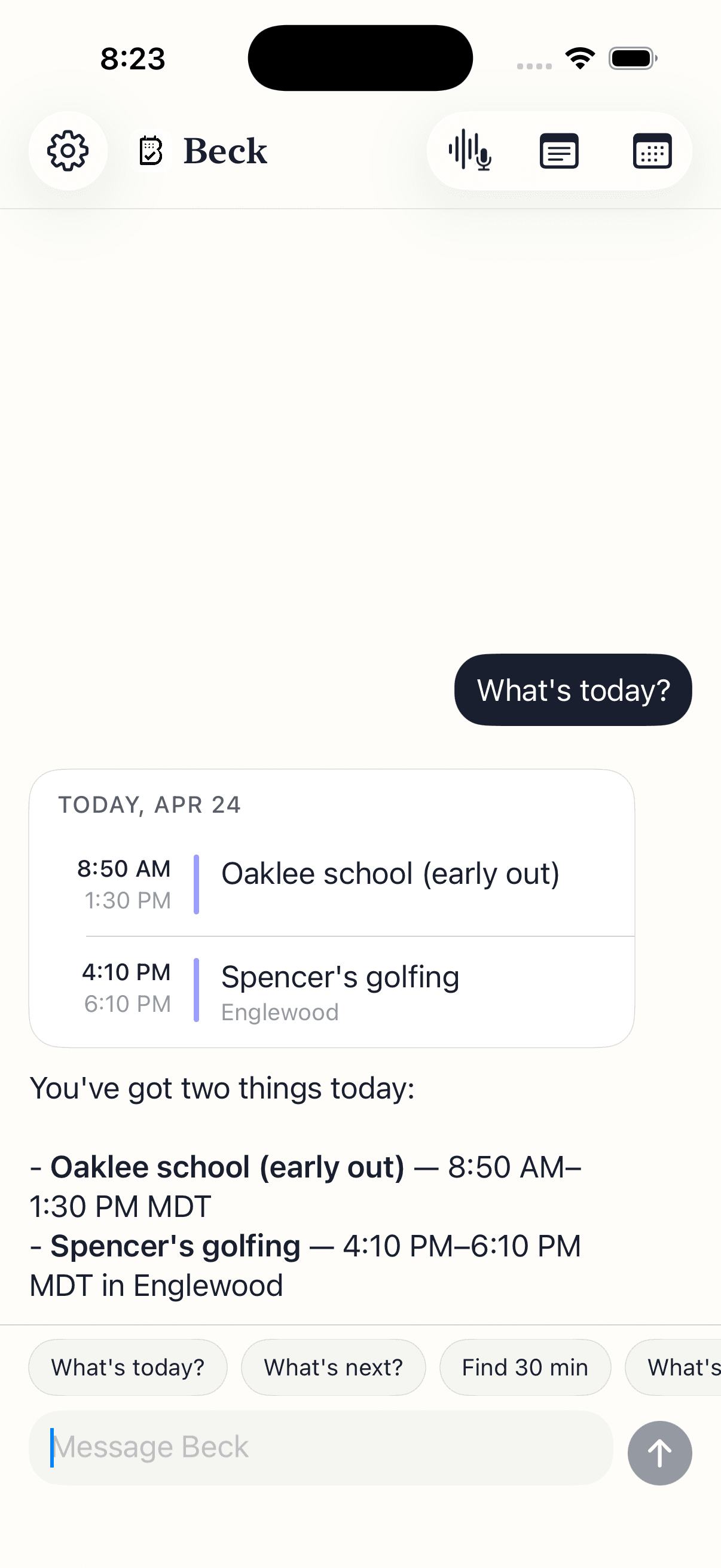
Not because you're careless — because the friction is higher than the thought lasts.
It surfaces mid-conversation: a follow-up, a birthday, a thing you promised. By the time you'd open the app and find the day, it's vanished. Say it out loud or type half a sentence and Beck AI drafts it on the spot — before the thought can leave.
The invite, the school sheet, the screenshot from the group chat. Adding it by hand is four taps too many, so it sits open in a browser tab for a week. Snap a photo instead. Beck AI reads it, pulls out every event, and you confirm the ones that matter.
If it's not in front of you, it isn't real — so the 3pm you didn't look at this morning may as well not exist. The daily brief is the fix: one message that reads the day back to you, so the events keep existing whether or not you remember to check.
You already moved it twice. Doing it again means facing the guilt and editing the recurrence by hand. With Beck AI it's one sentence — Beck AI redrafts, conflict-checks the new slot, and shows you. No streak to break, no tally of how many times you moved it.
The difference isn't features — it's how much friction sits between the thought and the record.
Your calendar is as private as your contacts. Nothing is sold, nothing trains AI, and nothing lands on your day until you tap confirm. That's the deal.
Every create, edit, and delete surfaces as a card. You see the draft before it touches your calendar.
Beck AI never trains on your calendar, your chats, or your notes.
Voice input is transcribed right on your phone. Only the current message travels so the AI can answer it — and it isn't retained after. Record a meeting and the audio is deleted the moment its transcript is ready.
Neither, and we won't pretend otherwise. Beck AI is a calendar — it doesn't diagnose, treat, or coach, and it makes no medical claims. What it does is lower the cost of capturing and keeping events, which is the part many people with ADHD describe as the hard part. If you want clinical support, talk to a clinician. If you want a calendar that doesn't punish you for being human, that's the part Beck AI is built for.
Because the gap between thinking of something and recording it is where things vanish. A normal calendar makes you open the app, find the day, tap new event, fill four fields, set a time, save. That's six chances to get pulled away. With Beck AI you type or say one sentence — "dentist next Thursday at 2" — or snap a photo, and Beck AI drafts the whole event. You glance at the card and tap confirm. Capture happens in the moment the thought exists.
Moving something should cost a sentence, not a mood. Tell Beck AI "push my 3pm to Friday morning" and it redrafts the event, checks the new slot against the calendar already on your phone, and shows you the result. Nothing lands until you confirm. There's no streak to break, no nag for the thing you moved twice, no record of how many times you rescheduled. You change your mind; Beck AI just updates the draft.
That's exactly what most people lean on it for. The morning brief is one quiet message that reads back what's already on today and what to prep — so you're not relying on remembering to check, or on holding the day in your head. It's on quiet days and silent when there's nothing. Read more on the AI daily brief, or see how Beck AI works across the calendars you already have.
No — that's the opposite of the design goal. Events get whatever alerts you'd normally set; there's no second reminder system layered on top, no badge anxiety, no "you haven't opened Beck AI in 3 days." The morning brief is the one steady touchpoint, and it stays silent on empty days. The point is less noise, not more.
Yes. Your chat history, meeting notes, and transcripts stay on the phone. Only the current request and the context needed to answer it leaves the device, and nothing is retained after the response. Nothing you do in Beck AI is ever used to train AI, and nothing is sold.
The next reschedule, school flyer, or “can we do Thursday?” takes one sentence.

 On your computer? Point your iPhone camera here.